
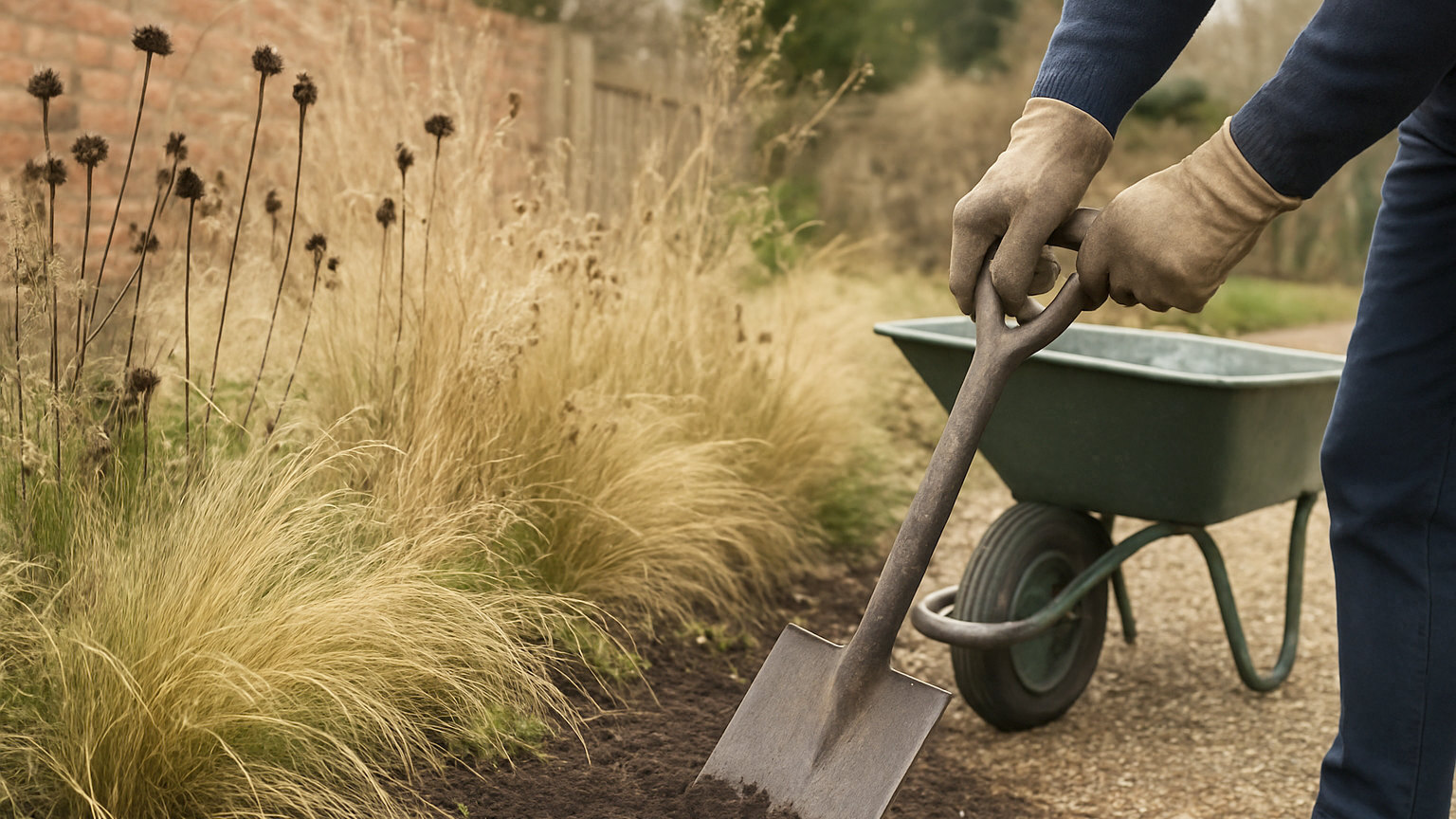
Naturalistic planting uses perennials and grasses in intermingled drifts, chosen as much for their form and their seedheads as for their flowers, and left standing through winter. It has become the dominant style in public planting and adapts well to gardens.
The principles
Plants are chosen for a long season of interest rather than a peak: strong flower shape, good structure, and seedheads that persist.
Grasses form a substantial proportion, giving movement, transparency and autumn presence.
Planting is intermingled rather than blocked, so species weave through one another as they would in a natural community.
Nothing is deadheaded, staked or cut back until late winter.
The result peaks in late summer and autumn, which is precisely when traditional borders are running out.
Plants that suit it
Strong flower forms: echinacea, rudbeckia, helenium, achillea, eryngium, veronicastrum, sanguisorba, monarda, phlomis, agastache.
Umbels and plates: achillea, fennel, ammi, angelica.
Spires: veronicastrum, salvia, digitalis, lythrum.
Transparent plants: verbena bonariensis, thalictrum, gaura.
Grasses: molinia, panicum, deschampsia, calamagrostis, miscanthus, stipa.
The common characteristic is that the seedhead is as good as the flower.
Two approaches to layout
Drift planting uses elongated interlocking groups of each species, running diagonally through the border, with gradual transitions rather than hard edges.
Matrix planting establishes a base layer, usually a grass, occupying perhaps half the planting, with other species distributed through it individually or in small groups.
Matrix planting reads as more natural and takes more confidence, since a plan of individual plants looks chaotic on paper and coherent on the ground.
Either way, repetition holds it together. The same species recurring throughout is what stops it becoming a muddle.
Soil matters more than in a conventional border
These plantings want poor to moderate fertility and good drainage.
Rich soil produces tall soft growth that flops and needs staking, which defeats the whole point.
Do not add manure or fertiliser. On heavy or fertile ground, a layer of sand or gravel across the surface reduces fertility and improves establishment.
Most of these plants originate in open grassland and want full sun.
Density
Plant considerably more densely than a traditional border, typically seven to nine plants per square metre for perennials.
The plants are intended to knit into a continuous community with no bare soil, which is what suppresses weeds and produces the natural effect.
Buying small plugs rather than large pots makes this affordable, and small plants establish better in dense planting.
Maintenance
Less than a conventional border, and different.
No deadheading, since the seedheads are the point.
No staking, if the soil is lean enough.
No feeding.
One cut a year, in late February, taking everything down before new growth starts. On a large area this is done with a strimmer or a powered hedge trimmer, and the material composted or shredded.
The ongoing work is editing rather than tending: removing species that are taking over, adding more of those that are struggling, and controlling self-seeding.
Winter is half the point
Standing seedheads and grasses under frost are as good as the summer display, and they feed birds and shelter insects.
Anyone unwilling to look at brown stems from November to February will not enjoy this style.
Adapting it to a small garden
The full effect needs space, and the principles scale down.
Use fewer species, repeat them more, include grasses, plant densely, choose things with good seedheads, and cut down in February rather than autumn.
Adding a clipped evergreen shape or two gives the eye somewhere to rest and stops a small area reading as untidy.
Where it does not suit
Shaded borders, damp heavy ground, small formal gardens, and anywhere a tidy appearance through winter is required.
Wildlife value
Considerable, and it is one of the strongest arguments for the style.
Single open flowers over a long season feed pollinators from June to October, the seedheads feed birds through autumn and winter, and the standing stems shelter overwintering insects.
Cutting down in February rather than autumn is what delivers most of that benefit, and it is also less work spread over fewer sessions.
Getting started
Begin with one border rather than the whole garden, choose eight or ten species including two or three grasses, plant densely, and resist adding more variety in the second year.
Buy plugs or small pots in quantity rather than large specimens, since dense planting is what makes the style work.


