
An existing border is easier to improve than to start again, and the improvement usually comes from subtraction. The instinct to buy more plants is nearly always the wrong first move.
Assess before acting
Watch the border for a full year, photographing it monthly from the same spot.
Note what performs and for how long, what is flopping, what is being smothered, what has died out in the centre, and which months are empty.
Do not remove anything in the first year unless it is clearly dead, since bulbs and late perennials appear at different times.
The common problems
Too many varieties, one of each. The border reads as a collection rather than a composition.
No structure. Nothing is visible in February.
One dominant plant that has spread and smothered its neighbours.
Congested clumps that have died out in the middle and flower poorly.
Everything flowering in June and nothing after July.
Bare soil between plants, growing weeds.
Plants in the wrong conditions, struggling permanently.
Edit first
Remove anything that is struggling in the wrong conditions, since it will never do well.
Remove or drastically reduce anything that has taken over. Ground elder is one problem; an over-vigorous ornamental is another and easier to solve.
Remove anything you do not actually like. Gardens accumulate plants that were inherited, given or bought on impulse, and there is no obligation to keep them.
Take out the surplus varieties where you have one of each of many, keeping the ones that perform.
A border usually looks better immediately after this stage, before anything has been added.
Divide and replant
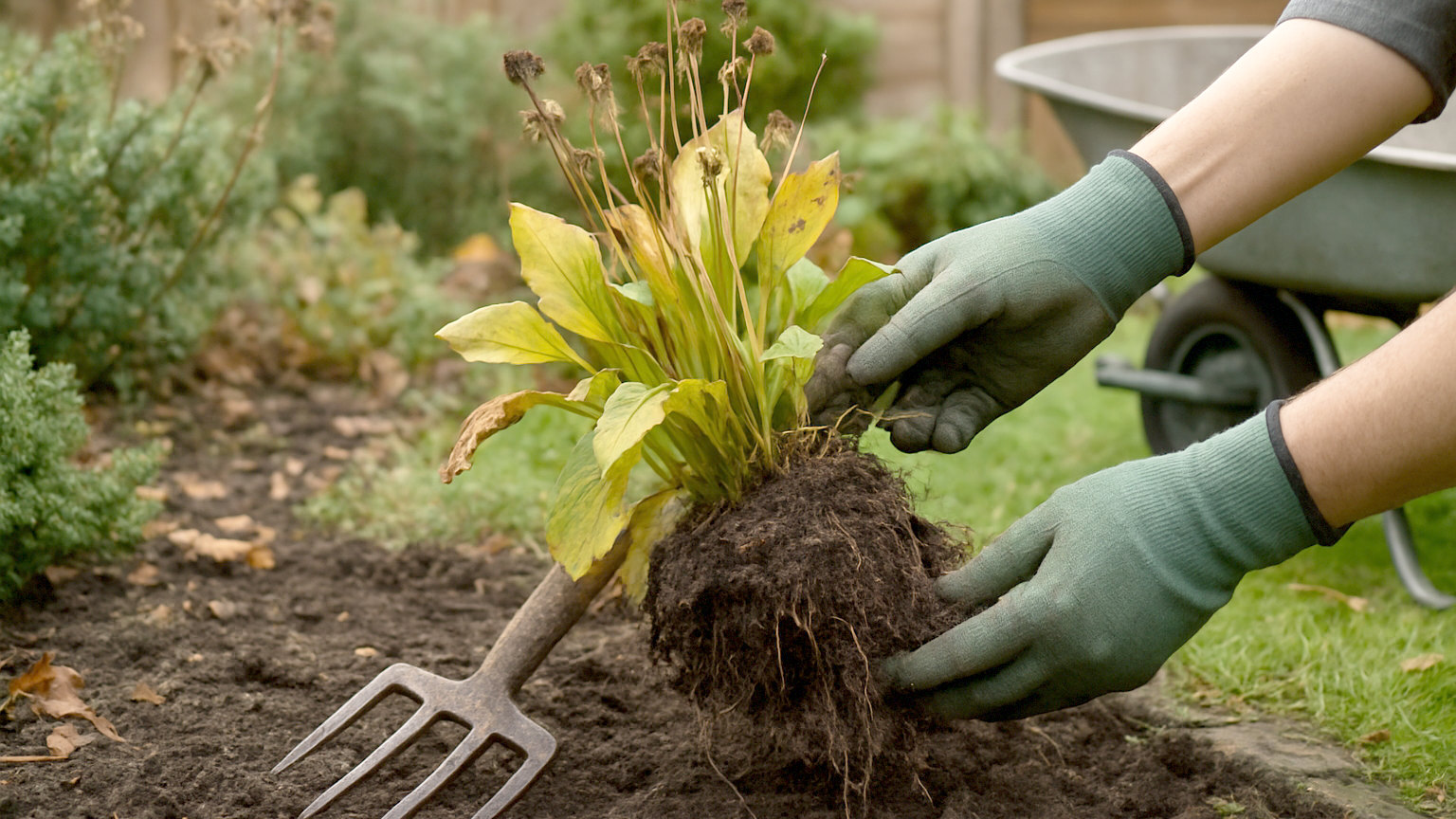
Lift congested perennials and divide them, discarding the woody dead centre and replanting the vigorous outer sections.
This is free plant material and it lets you group and repeat rather than leaving single specimens scattered.
Autumn or early spring for most perennials, and spring rather than autumn for grasses.
Improve the soil while the ground is open, and clear every fragment of perennial weed root, which is far easier now than later.
Then add, deliberately
Repetition. Buy three or five more of something already in the border and repeat it along the length. This does more than any new variety.
Structure. Two or three evergreens or clipped shapes, distributed rather than lined up at the back.
Bulbs in autumn, which extend the season for very little money and use ground already occupied.
Late performers if the border finishes in July: asters, hylotelephium, rudbeckia, japanese anemones, grasses.
Ground cover in the bare soil beneath shrubs.
Quick improvements
Cut a crisp edge with a half-moon iron, which transforms the look of a border in under an hour and costs nothing.
Mulch generously on moist soil in spring, which suppresses weeds, feeds the plants and makes everything look intentional.
Support floppy plants in April rather than propping them in July.
Deadhead, and cut back geraniums, nepeta and alchemilla after their first flush for a second flowering.
Phasing the work
A border can be renovated a section at a time over two or three years, which spreads the cost and the disruption.
Where a border is entirely overrun with perennial weeds, the honest answer is to lift everything, wash the roots, clear the ground completely, and replant. It is drastic and it works, and half measures do not.
Resist the garden centre
Go with a list based on what the border needs in a specific month, and buy multiples of few varieties.
Buying whatever is flowering on the day is how the original problem arose in the first place.
Judging it afterwards
Give a reworked border two seasons before assessing it. Divided perennials take a year to establish and new planting takes two to fill out.
Photograph it monthly again, and repeat the process the following year. A border is edited continuously rather than finished.
When to start again instead
Where the ground is riddled with bindweed, ground elder or couch grass, or where the soil is exhausted and compacted, clearing entirely and replanting is quicker than years of partial improvement.
Lift what you want to keep, wash the soil off the roots, pot them up temporarily, clear the ground completely over a season, and replant into prepared soil.


