
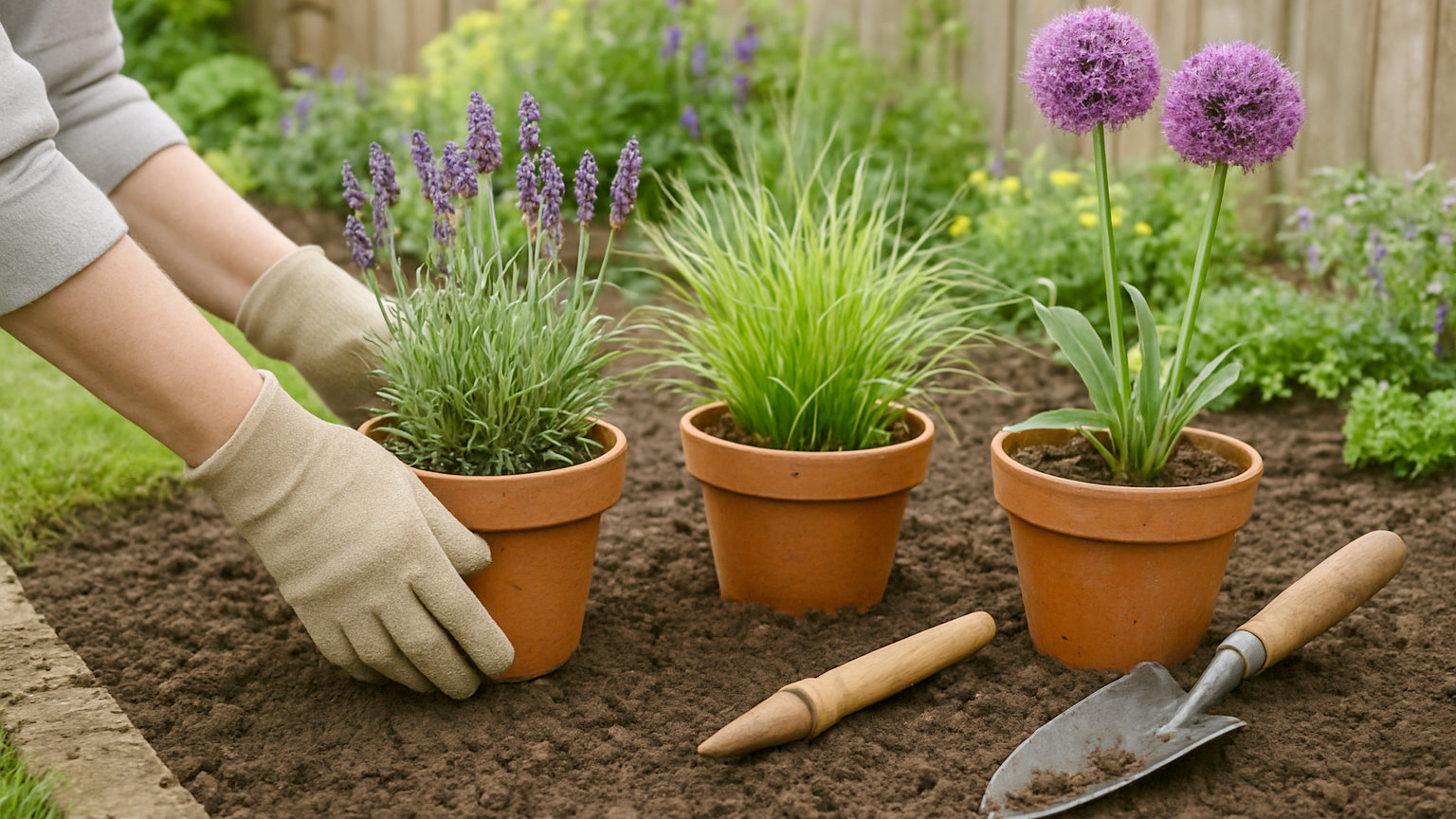
A border that works is built in a specific order: structure first, then the seasonal layers, then colour. Choosing plants you like and finding somewhere for them produces a collection rather than a planting, and the difference is obvious even when every individual plant is good.
Structure first
Start by placing the plants that hold the border together all year. Evergreen shrubs, small trees, clipped shapes and anything with a strong architectural form.
A useful working figure is that about a third of the planting should be evergreen if the border is to read as a garden in January. Space these through the bed rather than lining them at the back, so the structure runs the length of it.
These are the bones. Everything else fills in around them, and a border with good bones survives the months when nothing is flowering.
Then the seasons
Work through the year and check you have something for each part of it. Most borders are heavy on June and July and empty by September.
- Late winter - hellebores, snowdrops, winter-flowering shrubs, coloured stems
- Spring - bulbs, brunnera, pulmonaria, spring shrubs
- Early summer - geraniums, alliums, roses, foxgloves
- Late summer - salvia, echinacea, rudbeckia, dahlias, grasses
- Autumn and winter - seedheads, grasses, berries, leaf colour
Bulbs are the cheapest way to fix a gap, since they occupy space that later plants will fill and disappear once done.
Layering by height
The old rule of tall at the back, short at the front is a starting point rather than a law. Following it rigidly produces a tiered bank that looks artificial.
Better to broadly grade the heights but let some tall, transparent plants come forward. Verbena bonariensis, tall grasses and Gaura are see-through, and placing them near the front adds depth without hiding anything behind.
Aim for a rough ratio of a third structure, a third mid-height perennials and a third ground cover and low planting.
Drifts and odd numbers
Plant in groups of three, five or seven rather than singly. A lone plant reads as a specimen and disappears; a group reads as a block of colour and texture that the eye recognises.
Odd numbers work because they do not resolve into obvious pairs, so the group looks natural rather than arranged. Above about seven the number stops mattering.
Plant in elongated drifts running through the border rather than in circular clumps. Drifts interlock with one another and look like the plants have spread there.
Repetition is what makes it look designed
Repeating the same plant at intervals along a border ties the whole thing together, and it is the single technique that most distinguishes a designed planting from an accumulated one.
Pick two or three plants and repeat them at intervals. A recurring evergreen shape, a grass and one strong perennial will do it. The eye follows the repetition and reads the border as a composition.
Limit the palette
Restricting yourself to two or three colours plus green produces a calmer, more considered result than using everything. It is much harder to make a border of every colour look intentional.
Hot colours, meaning reds, oranges and yellows, advance towards the viewer and make a space feel smaller and more energetic. Cool colours, blues, purples and whites, recede and make a garden feel larger and more restful, which is worth knowing in a small plot.
White and silver foliage links disparate colours together and lifts a shaded area.
Foliage does most of the work
Flowers last weeks; leaves last months. Build the planting on contrasting foliage shapes, the strappy against the rounded, the ferny against the broad, the matt against the glossy.
A border composed entirely of foliage can be excellent. A border relying entirely on flowers has long periods of nothing.
Draw it before you buy
Sketch the border to scale and draw the plants as circles at their mature spread. It shows immediately how many you need and stops the usual pattern of buying whatever looks good at the garden centre and finding room for it afterwards.
Check the eventual size
Space plants at their mature spread, not their current size. It looks sparse for two seasons and correct thereafter, and annuals or bulbs will fill the gaps meanwhile.
Overplanting is the most common error, and it leads to a congested border within three years where everything competes and nothing performs.


