
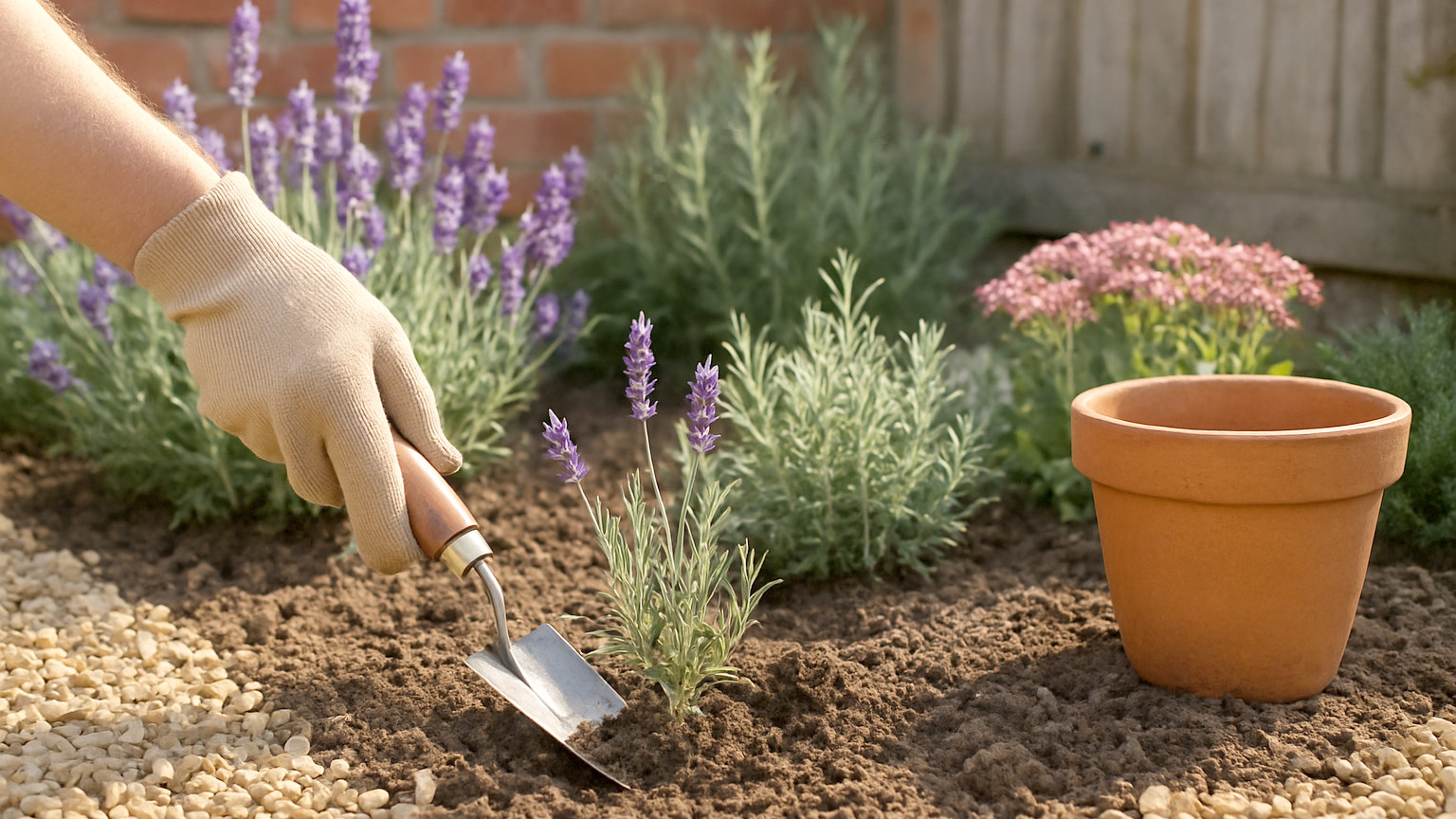
A hot dry border is one of the easiest plantings to maintain once established, and the mistakes people make are all attempts to be helpful: improving the soil, feeding, and watering.
What thrives there
Shrubs and sub-shrubs: lavender, rosemary, cistus, santolina, phlomis, perovskia, caryopteris, hebe, cytisus, helianthemum, artemisia, teucrium.
Perennials: eryngium, echinops, achillea, hylotelephium, euphorbia, nepeta, salvia, verbascum, stachys, gaura, dianthus, kniphofia, agapanthus, penstemon.
Grasses: stipa, festuca, pennisetum, helictotrichon.
Bulbs: alliums, nerines, species tulips, agapanthus.
Annuals: Californian poppy, nasturtium, cosmos, calendula.
Look for the physical signs of adaptation: silver or grey foliage, hairy or felted leaves, small narrow or needle-like leaves, waxy surfaces, aromatic foliage and succulent leaves. All indicate a plant built for dry conditions.
Do not improve the soil
This runs against every instinct and it matters.
Rich soil produces soft sappy growth with less scent, fewer flowers, reduced hardiness and a shorter life.
These plants evolved on poor stony ground. Adding manure and fertiliser makes them flop, mildew and die younger.
Do add grit for drainage. Do not add compost for fertility.
Drainage is what kills them
Almost all of these plants survive hard frost and die of winter wet.
Roots sitting in cold saturated soil through January rot, and the plant collapses in spring just as everything else starts growing.
Add plenty of horticultural grit at planting, plant slightly proud of the surrounding soil, and improve the drainage of the whole area rather than individual holes.
On heavy clay, build a raised bed or use containers rather than fighting the ground.
Gravel mulch
The right mulch for this planting, for several reasons.
It keeps the crowns of the plants dry, which is what prevents rot.
It retains moisture beneath while the surface stays dry, which suppresses weeds.
It does not feed the soil, which is the point.
It reflects heat and looks appropriate to the style.
Apply five to seven centimetres. Plant through it into the soil beneath rather than into the gravel itself.
Do not lay membrane underneath. It prevents the self-seeding that makes these plantings look natural over time, and it causes problems within a few years as debris accumulates on top.
Establishing it
Drought tolerance applies to an established plant, not to one planted last month.
Water thoroughly and regularly through the first growing season, and in dry spells during the second.
Then stop, which is the part people find difficult. Continuing to water produces shallow roots and a plant that never becomes independent.
Plant in autumn or spring rather than summer, giving roots time to develop before facing heat.
Maintenance
Very little. No feeding, no routine watering.
Never cut lavender, rosemary, cistus or santolina back into bare wood, since they will not reshoot from it. Trim lightly after flowering, always leaving green growth below the cut, and do it every year from the moment a plant is young.
Many of these shrubs are short-lived, at five to ten years. Take semi-ripe cuttings in late summer so replacements are ready, since they root very easily.
Allow self-seeding, which fills gaps and makes the planting look established.
What it gives
A border that looks good through a hot summer when conventional planting is flagging, needs no watering, supports pollinators heavily, and asks for a light trim once a year.
Where it will not work
Shade, where all of these become drawn and rot. Heavy wet clay without drainage improvement. And exposed cold frost pockets, where several are borderline.
Combining the plants
These plants suit each other because they want the same conditions, so the border reads as a coherent planting rather than a collection.
Silver foliage, grasses and strong flower shapes such as eryngium and allium combine particularly well, and the whole planting stands up in a hot summer.
Repeat a few plants through the border, as in any planting, and include one or two clipped evergreens to give the eye somewhere to rest among the loose growth.
Extending the season
These borders peak in midsummer. Species tulips and alliums extend them backwards into spring, and nerines, hylotelephium and late grasses carry them well into autumn.
Seedheads on eryngium, echinops and phlomis stand through winter and look striking under frost, so leave them until February.


