
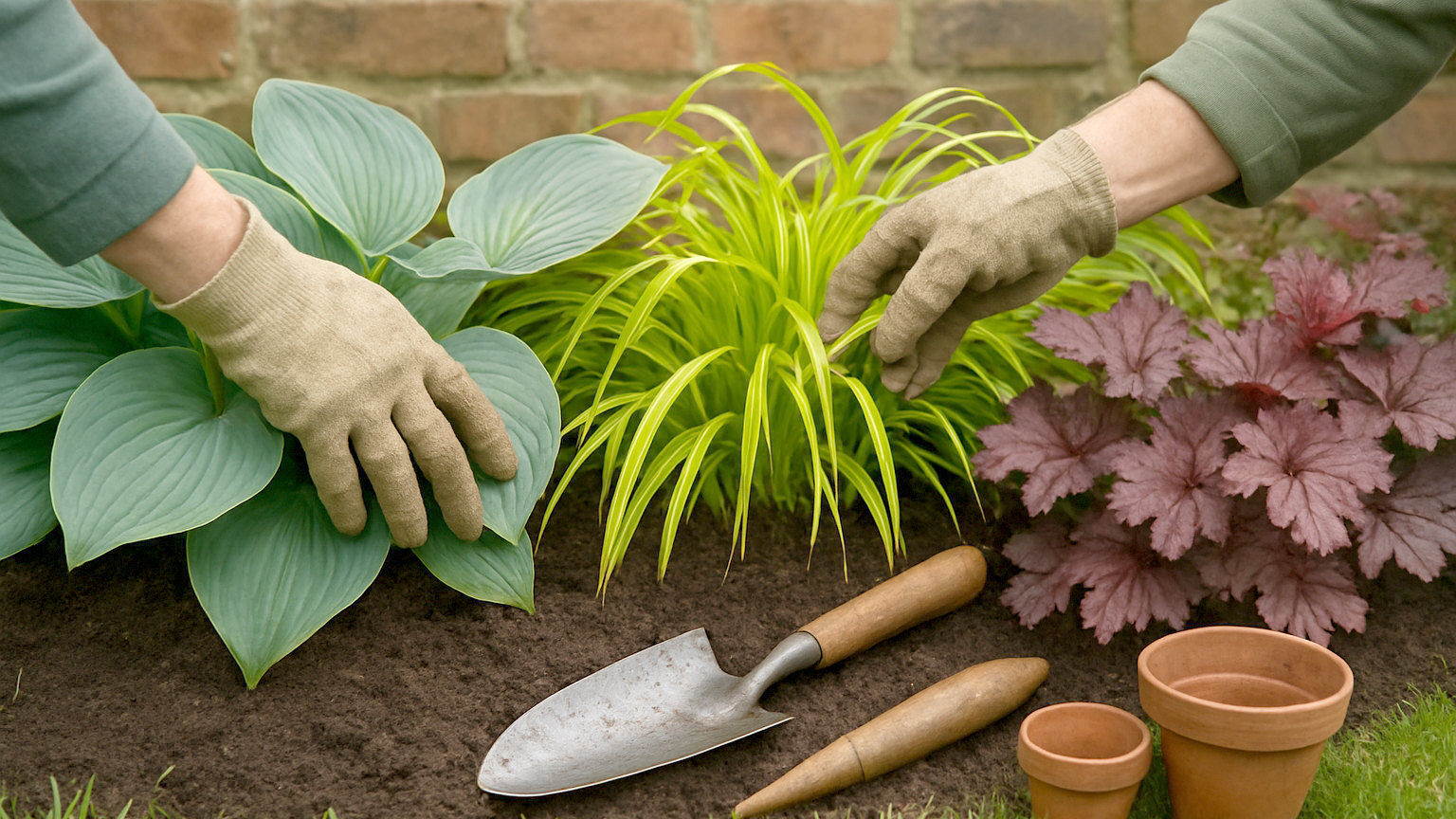
Most flowers last two or three weeks. Foliage lasts six months, or all year on evergreens. A border built on leaf shape, texture and plant form works for the whole season, and the flowers become a bonus.
Leaf shape
The strongest contrasts come from putting different leaf shapes together.
Strappy and sword-shaped: iris, crocosmia, phormium, day lilies, grasses.
Broad and rounded: hosta, bergenia, brunnera, ligularia, alchemilla.
Fine and feathery: fennel, ferns, astilbe, achillea, dill, cosmos.
Palmate and hand-shaped: acer, rodgersia, hardy geranium, lupin.
Spiky and architectural: eryngium, acanthus, cardoon, yucca.
Placing a broad rounded leaf beside a fine feathery one makes both look better than either would among its own kind.
Texture
Separate from shape and equally useful.
Glossy leaves reflect light and read as bright. Matt leaves absorb it. Felted and hairy foliage catches the light differently again and appears silver.
Fine-textured planting recedes and makes a space feel larger; bold-textured planting advances and makes it feel smaller.
Use fine textures at the far end of a small garden and bold ones near the house.
Plant form
The overall shape of the plant, which reads from a distance where leaf detail does not.
Vertical spires: foxglove, delphinium, veronicastrum, verbascum, lupin, digitalis.
Flat plates and umbels: achillea, sedum, ammi, fennel, angelica.
Rounded mounds: hardy geranium, nepeta, hebe, box.
Airy and transparent: verbena bonariensis, gaura, thalictrum, stipa.
Spherical: alliums, echinops.
Mixing forms is what gives a border interest at a glance. A border of nothing but mounds is dull however good the colours.
The useful combination
A commonly cited approach is to combine spires, plates and mounds in every group, with something airy threading through.
Vertical spires give height and rhythm, flat plates provide horizontal contrast, mounds fill and settle the composition, and transparent plants soften and connect.
This works at any scale and in any style, and is a reliable way to build a group of plants that looks considered.
Foliage colour
Green varies enormously, and the variation carries a border for months.
Silver and grey foliage lightens a scheme and separates strong colours: artemisia, stachys, santolina, senecio.
Purple and bronze foliage adds depth and weight: heuchera, cotinus, sambucus Black Lace, ophiopogon.
Lime and gold foliage lifts shade: hakonechloa, golden hop, philadelphus Aureus, milium.
Variegated foliage brightens dark areas and is best used sparingly, since too much reads as busy.
Transparency
Plants you can see through change how a border reads.
Verbena bonariensis, thalictrum, gaura, molinia and stipa can be placed at the front of a border rather than the back, veiling what is behind them and adding depth.
This is one of the most useful tricks in modern planting design and it costs nothing.
Seedheads and winter form
Many plants are as good in seed as in flower, and leaving them standing extends the border by months.
Sedum, echinacea, eryngium, phlomis, teasel, alliums and grasses all hold their structure through winter and look superb under frost.
Cut back in late February rather than autumn, which also shelters overwintering insects.
Testing a combination
Stand plants together in their pots before planting and look at them from a distance, half closing your eyes so the colour drops out and only shape and texture remain.
If the combination still works with the colour removed, it will work in the border. If it only works because of the flowers, it will look flat for most of the year.
Evergreen foliage
The foliage that matters most is the foliage present in February. A border with no evergreen leaf is bare ground for four months whatever it does in summer.
Aim for around a third of the planting to have some permanent presence, distributed through the border rather than concentrated at the back.
Where to use bold foliage
Large-leaved plants such as hosta, ligularia, rodgersia and fatsia carry a shaded border on foliage alone, since flowers are scarce there and leaves are not.
Bold foliage also anchors a loose planting, giving the eye somewhere solid among fine textures.
Combining foliage colours
Silver with purple is a reliable pairing. Lime green with dark bronze is another. Grey-green with glaucous blue reads as a single restrained scheme.
Keep variegation to a small proportion, since several variegated plants together compete and look restless.


