
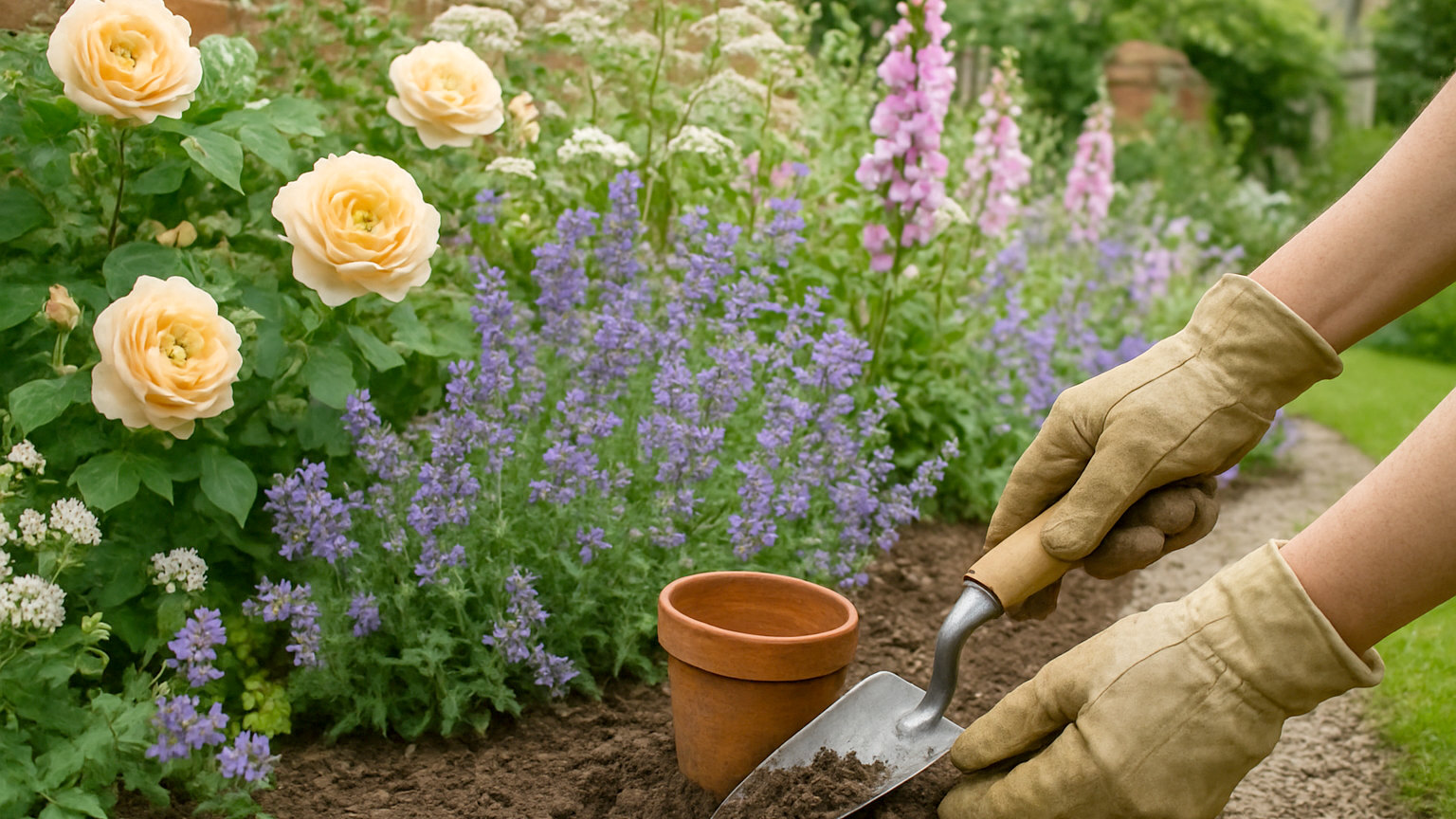
The cottage garden style is generous, informal and apparently artless. The apparent artlessness is the difficult part, since abundance without any underlying discipline becomes a mess rather than a cottage border.
What defines it
Dense mixed planting with little bare soil.
Old-fashioned flowers, many of them scented.
Flowers, herbs, fruit and vegetables mixed together rather than separated.
Self-seeding allowed and encouraged.
Informal shapes, generous overflowing edges, and plants allowed to flop onto paths.
Historically it was practical rather than decorative: a small plot growing food, herbs and a few flowers together, and the style descends from that.
The plants
Perennials: lupins, delphiniums, hardy geraniums, peonies, phlox, campanula, aquilegia, achillea, catmint, oriental poppies, hollyhocks, penstemon, astrantia.
Biennials: foxgloves, wallflowers, sweet william, honesty, forget-me-nots.
Annuals: sweet peas, cornflowers, nigella, calendula, cosmos, larkspur, nasturtiums.
Roses: old garden roses, English roses and ramblers, chosen for scent.
Shrubs: philadelphus, lilac, buddleja, lavender, rosemary.
Bulbs: snowdrops, daffodils, tulips, alliums.
Edibles: herbs throughout, runner beans on a wigwam, a trained apple, currants and gooseberries.
Keeping it from becoming chaos
This is the whole difficulty, and the answer is structure beneath the exuberance.
Firm edges. A crisp lawn edge, a brick path or a low hedge contains the planting and makes the overflow read as deliberate. Cottage planting spilling over a hard edge looks generous; the same planting with a ragged edge looks neglected.
A clear path layout. Straight paths and simple geometry beneath informal planting is the classic and most successful combination.
Repetition. Even here, repeating a few plants through the border ties it together.
Some evergreen structure, clipped or otherwise, to hold the border in winter when cottage planting is at its thinnest.
Editing. Removing plants that have taken over is the main annual job.
Self-seeding
Central to the style and the thing that makes it look unplanned.
Foxgloves, aquilegia, honesty, forget-me-nots, nigella, calendula, poppies, verbena bonariensis and hellebores all seed themselves generously.
Seedlings appear where conditions suit them and are frequently better placed than anything you would have chosen.
The skill is in editing: thinning where they are too thick, removing them where they are wrong, and moving them where they are useful.
Learn to recognise the seedlings so you do not hoe them off in spring.
Support
Cottage plants flop, and dealing with it early is what separates a good cottage border from a collapsed one.
Put supports in during April and May while plants are small, using pea sticks, link stakes or wire hoops that the growth grows up through and hides entirely.
Staking after a plant has gone over never looks right.
Scent
Traditionally central. Plant scented things beside paths, by doors and around seats where they will be encountered.
Sweet peas, roses, philadelphus, lilac, pinks, lavender, nicotiana and honeysuckle all belong.
Soil and maintenance
Cottage planting is hungry, unlike naturalistic or Mediterranean schemes.
Mulch generously each spring with compost or well-rotted manure, and feed the roses and anything cropping.
Divide congested perennials every few years, deadhead to keep things flowering, and cut back for a second flush in midsummer.
It is a higher-maintenance style than it appears.
Wildlife
A cottage border is excellent for pollinators, since it is dense, varied, mostly single-flowered and in flower from spring to autumn.
Leaving some seedheads standing over winter extends that benefit at no cost.
Where it suits
Country and village gardens, period houses, and anywhere an informal setting makes formality look out of place.
It works in a small garden too, since density is the point rather than scale, and a short border planted this way is as effective as a long one.
The underlying discipline
Cottage planting looks unplanned and depends on structure, repetition, firm edges and constant editing. Remove those and it becomes a thicket within three years.
A year in a cottage border
Bulbs in spring, then the biennials in May, the main perennial flush from June, annuals sown in gaps flowering from July, and a second flush from anything cut back in midsummer.
Divide and edit in autumn, mulch in spring, and put the supports in during April while everything is still small.
Leave some seedheads standing over winter for the birds and for the structure, and cut the rest down in late February.


