
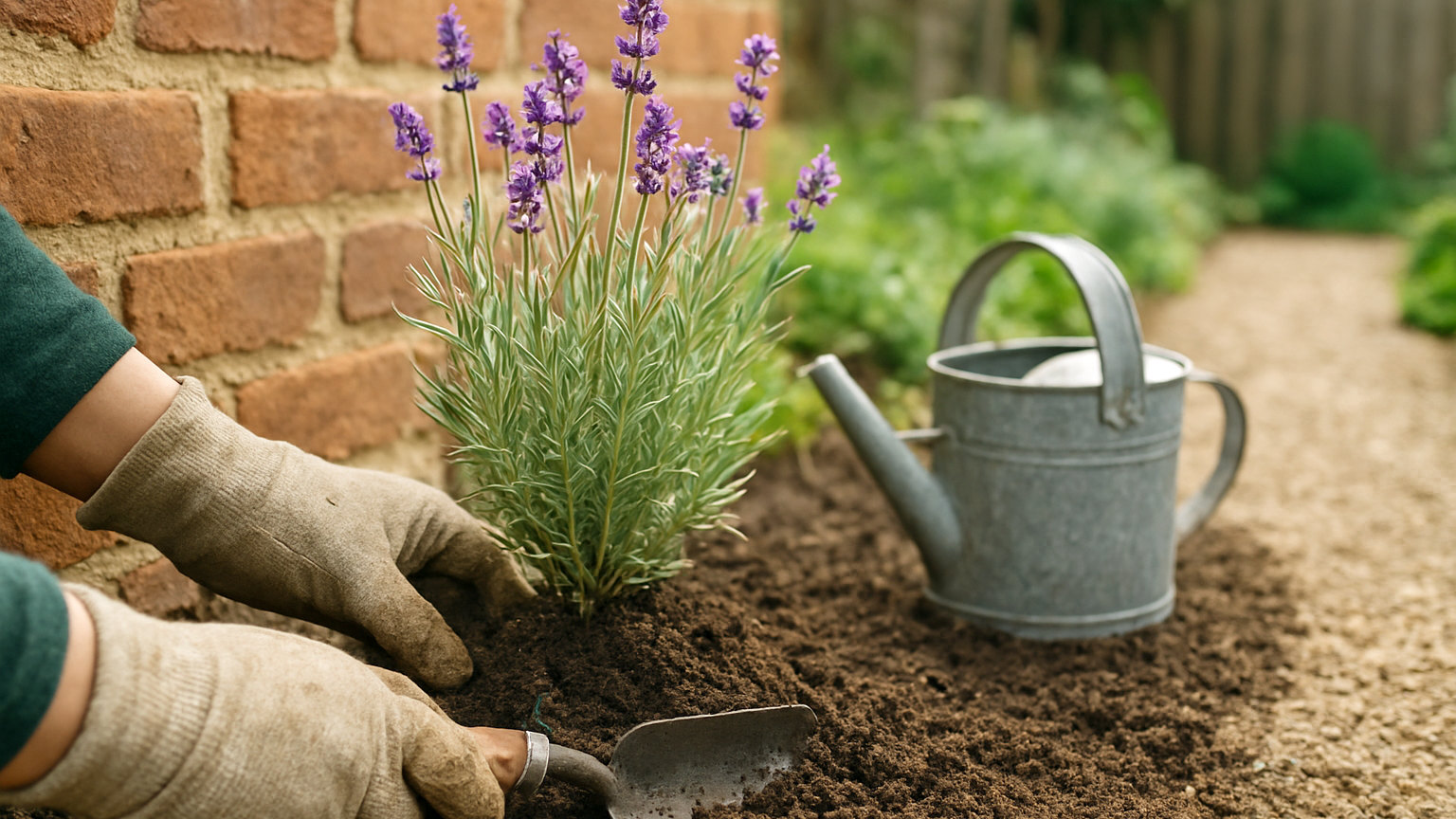
Borders against a boundary are the commonest kind in a domestic garden and the ones that most often disappoint. The reason is usually not the aspect but the dryness.
The rain shadow
The ground within about half a metre of a wall or fence is the driest in the garden.
Eaves and overhangs shed rain away from the base, the structure blocks rain driven by the prevailing wind, and masonry draws moisture out of the adjacent soil.
Soil at the base of a house wall may receive a fraction of the rainfall the open garden gets.
This defeats more wall plantings than shade, cold or soil type combined.
Plant away from the wall
Plant at least forty-five centimetres out, and further where you can, leaning the plant inwards towards the wall.
The roots then sit in ground that receives rain, while the top growth still reaches the support.
This applies to climbers, wall shrubs and border plants alike.
Check what is in the ground
The soil beside a house or a new fence is frequently full of builders' rubble, mortar droppings and subsoil rather than topsoil.
Dig a hole and look before planting anything. Mortar and concrete debris also raise the pH locally, which affects what will grow.
Remove rubble, replace with decent topsoil, and improve generously with compost.
Damp-proof course
Ground level must stay at least a hundred and fifty millimetres below the damp-proof course of a house.
Do not raise soil levels or pile mulch against a house wall, which bridges the damp course and causes damp inside.
Leave a clear gap of gravel or paving against the wall rather than bringing soil up to it.
Watering and mulching
Water thoroughly through the first two seasons and in every dry spell afterwards, which is more than a border in the open needs.
Mulch generously each spring on moist soil, keeping it clear of stems and away from the damp course.
A soaker hose along the base of a wall border, run for an hour at a time, is the practical answer for a long run.
Use the vertical surface
The point of a wall border is that it comes with several square metres of growing space above it.
Fit horizontal wires on vine eyes, spaced about forty-five centimetres apart, held ten centimetres clear of the wall so air circulates behind and stems can grip.
Trellis needs battens behind it for the same reason.
Train climbers horizontally, since a stem trained sideways flowers along its whole length while an upright one flowers only at the top.
By aspect
South and west: the warmest positions and the driest. Suits Mediterranean planting, roses, wisteria, figs and trained fruit, and borderline plants that would not survive elsewhere.
East: morning sun, which is a problem rather than a benefit for anything whose buds may be frosted, since rapid thawing damages them. Avoid camellias and magnolias here.
North: cool, shaded and often the easiest to plant well once the dryness is dealt with. Climbing hydrangea, ivy, some clematis, honeysuckle, and among shrubs pyracantha, chaenomeles and garrya.
Depth
A border against a boundary needs to be at least a metre and a half deep to hold a proper planting, and two metres is better.
A narrow strip along a fence dries out faster, holds only one row of plants and always looks thin.
Fewer, deeper borders read far better than a thin band round the entire perimeter.
Practicalities
Leave access to the fence for maintenance and repainting, or use a hinged trellis that can be lowered with the plant attached.
Remember you cannot fix anything to a fence you do not own without permission.
Consider what the boundary will look like when the planting is established, since a fence that needs treating every two years is awkward behind a mature border.
A wall, or a fence in a colour and material you will not need to change, saves a great deal of trouble later.
Hedges are different
A hedge behind a border competes aggressively for water and nutrients, unlike a wall.
Leave a gap of at least forty-five centimetres in front of it, water and feed the border generously, and expect the planting nearest the hedge to be the slowest.


