
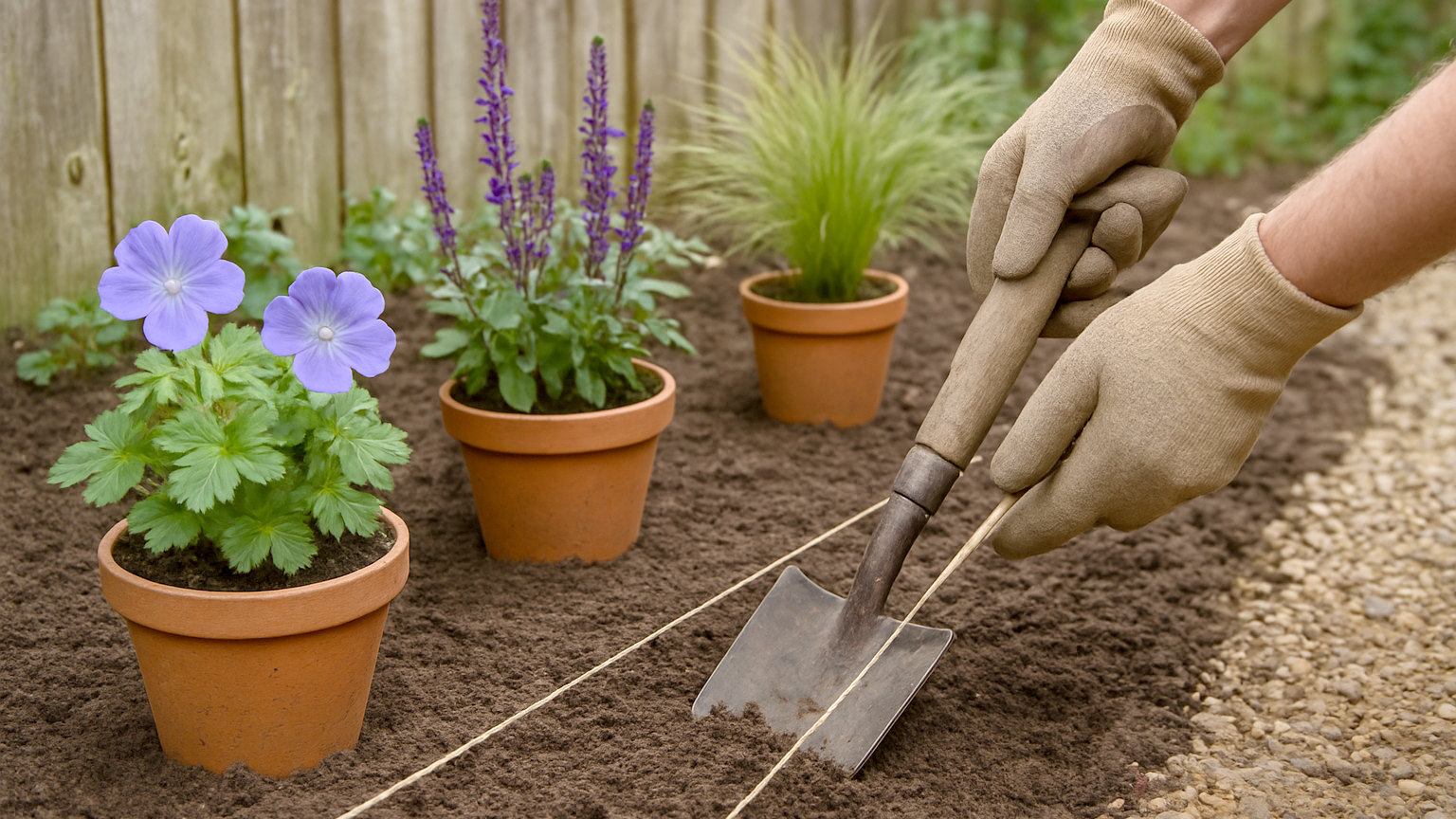
Two measurements determine whether a border works, and both are usually too small. The bed is too narrow to hold a layered planting, and the plants are set too close together because a young plant looks lost at its correct spacing.
How deep a border needs to be
A metre is the working minimum for a mixed border, and a metre and a half to two metres is where they start to look properly furnished. Anything under about sixty centimetres can hold only a single row and will always read as a strip rather than a planting.
The reason is layering. A border needs at least three depths of planting to look substantial: structure at the back, mid-height perennials, and lower planting at the front. A narrow bed physically cannot accommodate that.
Widening a border is usually the cheapest improvement available. Taking a metre off the lawn and adding it to the bed transforms how a garden reads, costs nothing but effort, and reduces mowing.
If you can only have a narrow bed, plant it deliberately as such: a repeated low hedge, a single repeated perennial, or climbers on the fence with one row beneath. That reads as intentional, where a narrow bed with one of everything does not.
Leave access behind
In a deep border against a fence, leave a gap of thirty to forty-five centimetres between the back of the planting and the boundary. It gives access for maintaining the fence, improves airflow, and stops plants being drawn forward towards the light.
It also means you can get to the back of the border without treading on everything at the front.
Spacing plants properly
Space at mature spread, not at the size in the pot. The label gives an eventual height and spread, and the spread is the number to work from.
For two plants side by side, the spacing between them is roughly the average of their two mature spreads. Two shrubs each reaching a metre wide go a metre apart, centre to centre.
As rough guidance by type:
- Herbaceous perennials - typically three to seven per square metre depending on size
- Ground cover - five to nine per square metre for reasonably quick coverage
- Small shrubs - sixty centimetres to a metre apart
- Medium shrubs - one to two metres apart
- Small trees - three metres or more from anything else, and from a building
Why overplanting fails
A border planted at correct spacing looks sparse for two seasons. That is uncomfortable and it is right.
Plants set too close compete for light, water and nutrients. Growth becomes drawn and weak, airflow drops so mildew and blackspot increase, and within three years you are removing plants or watching the vigorous ones smother the rest. Everything performs worse than it would with room.
The plants that suffer most are the ones you paid most for, since the cheap vigorous fillers win.
Filling the gaps in the meantime
There is no need to look at bare soil for two years.
Annuals sown in the gaps give a full border in the first summer and disappear afterwards. Cosmos, nigella, calendula and cornflower all work and cost very little.
Bulbs occupy space that later perennials will fill, flowering and dying back before the gap closes. Temporary containers dropped into the spaces work too, and can be moved as the planting fills in.
Mulching bare soil between plants suppresses weeds, retains moisture and looks considerably better than bare earth while you wait.
Shape and edges
Gentle sweeping curves read better than tight wiggles, which look busy and are awkward to mow around. Lay a hosepipe on the ground and adjust it until the line looks right, then cut to it.
A crisp cut edge, or a mowing strip of brick or paving set flush with the lawn, does more for the appearance of a border than almost anything within it.
Soil preparation before planting
Whatever the spacing, prepare the whole bed rather than individual holes. Fork over the area, remove perennial weed roots completely, and work compost through the top spit. Roots spread sideways far more than down, so improving a wide area matters more than digging deep.
Distance from a wall
Plant at least forty-five centimetres out from a house wall. The strip immediately against a building is dry, often full of builders' rubble, and sheltered from rain by the eaves, which is why plants put there so often fail.


